Everyone in business seems to be always talking about a project.
Whether it is something along the lines of I’m flying to the US for a couple of projects. Or This project is really pushing me. Or again Let’s please focus on project A.
If you live and breathe business, then you’ve definitely heard phrases like these countless times.
But what exactly is a project? How could we define it?
Sometimes coming up with a definition that simply ticks all the boxes and makes perfect sense for you is the first step to become great at handling the very thing you are defining.
So today we’ll be offering up our Intelness-coined definition of project, hoping to shed light on this hazy, overused concept.
It goes like this:
A project is an operational venture in which one or more teams work in synergy according to precise priorities and objectives, with the aim of producing a specific output or reach a defined outcome.
This is a formal definition, but if you look closely you’ll see some actionable inputs contained within. We’ll expand on all three of them here below.
A venture of operational nature
This means that a project, in order to be defined as such, needs to contain an operative core. The targets you’d like to reach by starting up a project are usually resulting from a strategy that’s under the hood, but a project is always correlated to actually doing things concretely. If you don’t structure your project around doing things that can be tracked and measured, how are you supposed to make things happen?
Organised synergy work
If the team involved in the project is of 500 people or of 2 people, the concept stays the same: everyone involved should have a clear role and take an active part in the project execution.
People should work on a project, not just muse on it or spending time getting aligned with it. It usually serves well to be decisive in adopting a “facts, not opinions” mental attitude. The best collaborations happen when everyone takes an active part in doing the work that brings the target closer and closer.
Precise set of priorities and objectives
Each project should have a goal defined clearly and transparently.
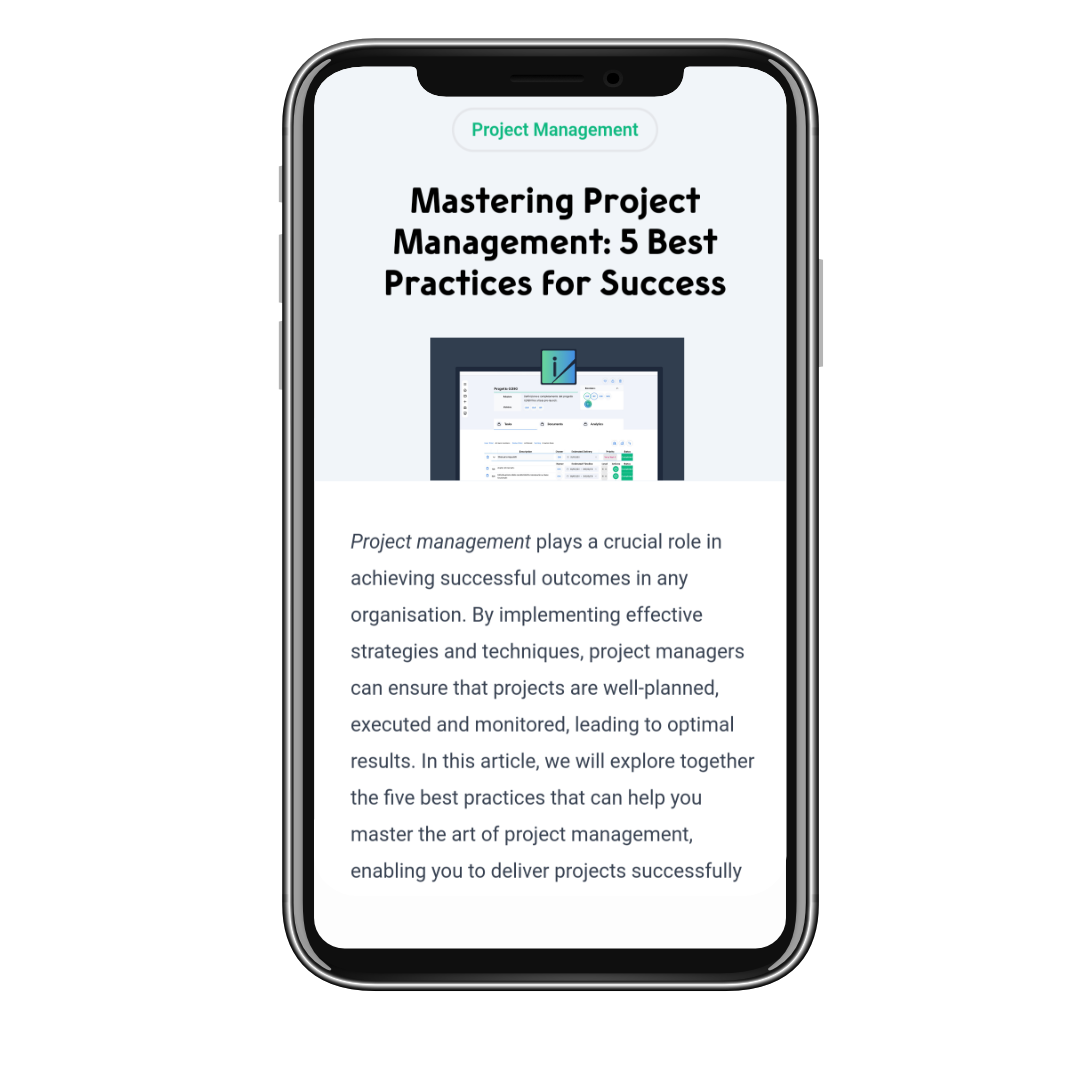
At Intelness, we call this project mission and we put it front and center on our project management tool, for everyone to see.
This mission is achieved by carrying out a series of macro-tasks that come with different priorities. Setting a specific priority level for each task is essential to make sure everyone’s doing what needs to be done, for sake of efficiency. It’s quite unsettling to spend time doing work that isn’t necessary or that will only become interesting a lot further down the line. Progress requires some discipline and discipline requires clarity.
If you’d like to take a look at the tool, feel free to book a custom demo with us or watch a recorded demo instead.
More things than you expect usually turn out to be a good “project”
Sometimes, you need to stretch your imagination.
Let us ask you:
what kind of organised activity could be better performed and produce better results if you were to manage it as a project?
You can take your time to find your own answer to this question, but we’ll provide here below a few ideas of activities and assignments that you can handle like a project (with great satisfaction).
Consider that Intelness project management tool is organised around three cores: macrotasks and tasks, documents, analytics. Each of these cores can be leveraged in many different ways and for different purposes.
Internal Product Developement (or Private Roadmap)
You can tranform your product development or private roadmap in a project, like this:
- each macrotask is a feature or functionaly area of the product
- each task is a sub-feature or sub-functionality to be implemented in order to deliver the feature or functionality
- documents are product specifications, technical papers or Q&As, requirement list and so on
- analytics for a quick overview of the development status
Content marketing
For content marketing, we personally use:
- macrotasks as timeline clusters, i.e. a macrotasks is “July 2023 publication schedule”
- tasks as actual content space or as subject lines with links to the actual content
- documents for strategy, specific implementation guidelines, ideas and organised topic discussions
- analytics to make sure at a glance if you’re on track with both scheduling and publishing